PolyGel vs. Builder Gel: Differences and When to Use Which?
PolyGel, PolyLiquid, Builder Gel – nail modelling is full of terms that sound similar but describe different materials. If you can tell them apart with confidence, you can choose the right product for every client and work more efficiently. In this article we explain the differences and show when each material is the right choice.
What is PolyGel?
PolyGel (also called acrygel) is a hybrid material that combines the properties of gel and acrylic. It has a thick, paste-like consistency, does not run and does not self-level. Unlike classic acrylic, it is cured in a UV/LED lamp.
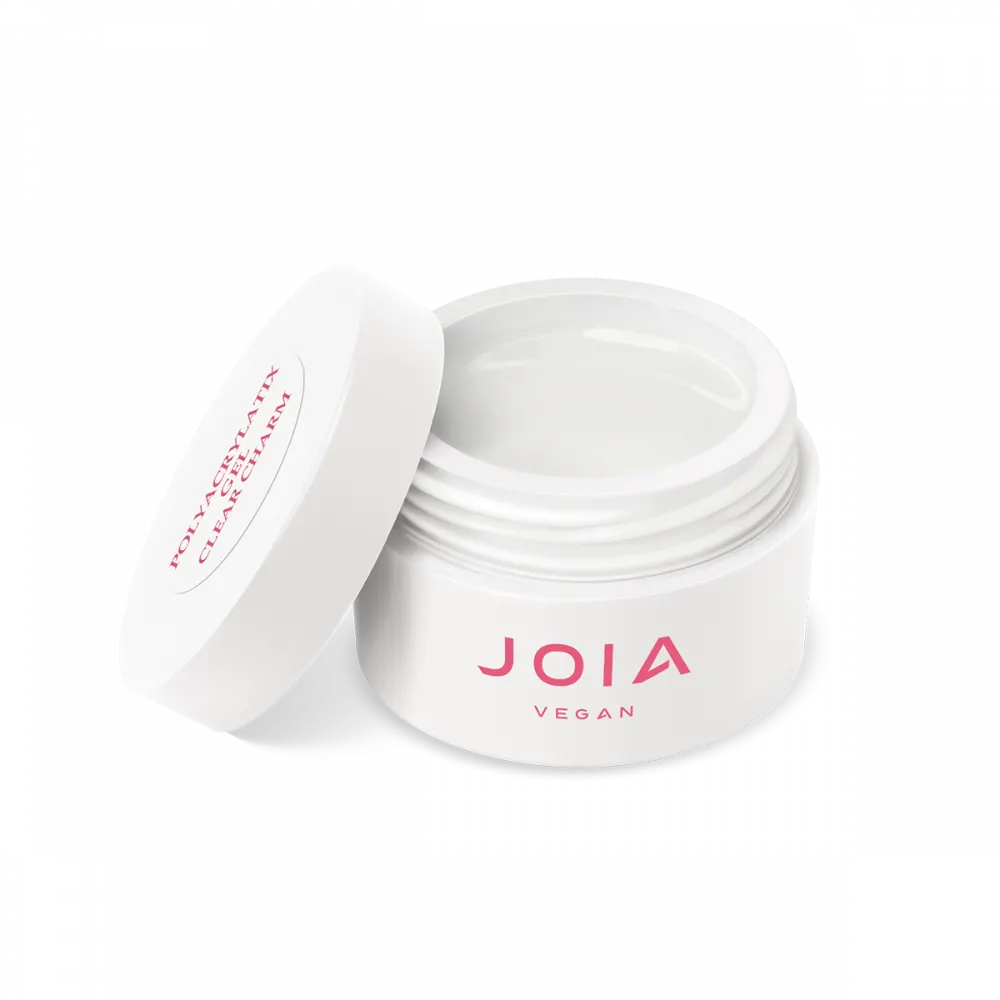
One example is the JOIA vegan PolyAcrylatix Gel Clear Charm. According to the manufacturer, it combines properties of builder gel and acrylic gel, is suitable for building and extending nails of any length and is easy to file. Another line is the MOLEKULA Polygel N°04 Cover, which can be worked with a brush or with dual forms.
Typical for PolyGel: the material is picked up with a spatula, placed on the nail and shaped with a brush dipped in a special liquid. One option is the JOIA vegan Liquid Polygel Easy Slip Solution. It stops the PolyGel from sticking to the brush. The liquid is applied only to the brush, not directly to the nail.
And what is PolyLiquid?
The name is easily misleading: PolyLiquid Gel is not a paste-like PolyGel. PolyLiquid gels from JOIA vegan are a 2-in-1 base and builder gel – medium viscosity with good self-levelling. They are applied straight from the bottle with a brush and, according to the manufacturer, are suitable for strengthening, levelling, repairs and building structure.
In practice, PolyLiquid is closer to a liquid builder gel than to a PolyGel. It is ideal when you want to strengthen the natural nail and create a beautiful shade or nude look at the same time.
What is builder gel?
Builder gel is a classic UV/LED gel for modelling, extensions, strengthening and repairs. Depending on the product, it is thick or medium viscosity and often has a thixotropic effect: it becomes more fluid when moved and holds its shape at rest. Unlike PolyGel, builder gel is at least partly self-levelling.
Examples include the milky DNKa’ Builder Gel #0002 Angel or the Creamy Builder gels from JOIA vegan. Both lines are available in several shades.
The differences compared
| Feature | PolyGel | PolyLiquid | Builder Gel |
|---|---|---|---|
| Consistency | paste-like, mouldable | medium viscosity, fluid | thick to medium viscosity |
| Self-levelling | no | yes | partly, depending on the product |
| Application | spatula and brush with slip liquid | brush from the bottle | brush |
| Typical use | extensions, modelling with dual forms | strengthening, levelling, repairs | modelling, extensions, strengthening |
| Curing | UV/LED lamp | UV/LED lamp | UV/LED lamp |
When to use which?
PolyGel: for controlled extensions
PolyGel shows its strengths when you need time for shaping. Because it does not run, you can model calmly before curing. Dual forms reduce filing time. Well suited for extensions and for nail designers who have previously worked with acrylic.
PolyLiquid: for strengthening the natural nail
If your client wears her own nail length and just wants more stability, PolyLiquid is a practical choice. It flows evenly, smooths out unevenness and can serve directly as a coloured base.
Builder gel: the all-rounder for modelling
Builder gel is the classic material for gel modelling on forms or tips. Thanks to self-levelling, you quickly get a smooth surface that needs little finishing.
Step by step: extensions with PolyGel
- Prepare the nail: Do the manicure, buff the nail surface, remove dust and degrease.
- Build adhesion: Depending on the system, apply primer and a thin base and cure according to the manufacturer’s instructions. JOIA vegan recommends the Latex Base under the PolyAcrylatix Gel.
- Apply the form or dual form: Choose a form for the desired length and position it neatly.
- Pick up the PolyGel: Take the required amount with the spatula and place it on the nail or in the form.
- Shape: Lightly moisten the brush with slip liquid and spread the material evenly. Make sure you have a clean apex and an even transition to the cuticle.
- Cure: Cure in the UV/LED lamp according to the manufacturer’s instructions.
- Refine the shape: Remove the sticky layer, file the shape and surface, and remove the dust.
- Finish: Design with gel polish and top coat or seal directly with top coat.
Common mistakes
- Too much slip liquid: A brush that is too wet can change the structure of the PolyGel. Only moisten the brush lightly.
- Material on the cuticle: Whether PolyGel or builder gel – the material must not touch the skin, otherwise lifting is likely.
- Treating PolyLiquid like PolyGel: PolyLiquid is fluid and self-levelling. For long, free-edge extensions, a paste-like PolyGel or a thick builder gel is the better choice.
- Curing layers that are too thick: It is better to build up in several steps so that the material cures completely.
FAQ on PolyGel and builder gel
Is PolyLiquid a PolyGel?
No. PolyLiquid Gel from JOIA vegan is a 2-in-1 base and builder gel with a fluid, self-levelling consistency. PolyGel such as the PolyAcrylatix Gel is paste-like and is worked with a spatula and slip liquid.
Do I need a special liquid for PolyGel?
Yes, for shaping, the brush is moistened with a slip liquid, e.g. the Easy Slip Solution. It prevents the material from sticking to the brush.
Which is easier for beginners?
That depends on your technique. PolyGel is forgiving because it does not run. Builder gel takes a little practice with self-levelling, but quickly gives a smooth surface.
Can I combine PolyGel and builder gel?
Follow the manufacturer’s recommendations. The safest approach is to work within one system, i.e. base, building material and top coat from the same brand.
Conclusion
PolyGel is paste-like and ideal for controlled extensions, PolyLiquid strengthens the natural nail as a fluid 2-in-1, and builder gel is the versatile all-rounder for modelling. You will find all of these materials in our category UV Gel.